Wild Wild Westworld
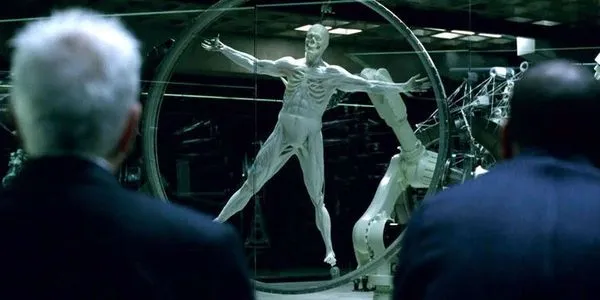
Minor spoilers of the Westworld Television show (and the 1970s cult-classic Movies, for that matter).
Sometimes while I’m working I put on a TV show or Movie I’ve watched numerous times - helps me focus a bit while I’m deep in work to have one whose plot (& often much of the dialogue) I already have partially or fully memorized.
This weekend, that was Westworld Season 1 (we don’t talk about the other seasons, I just pretend the seasons where the show jumped the shark don’t exist).
What I like about having creative / fictional stuff running on the side is it helps my creative juices / thoughts as I’m working through problems.
It helped remind me that I still haven’t written about why I mirrored the Westworld Television show’s “Delos” interface / UI / UX in the frontend of my personal JohnClick.ai website.
Bottom-line: it’s because I wanted the FORM of the website to inform how I function with AI.
The themes the show explored around AI, AI Alignment, LLMs, Agent Loops, Superintelligence, and more are important ideas to keep in mind whenever working with AI, in my opinion.
Thus, I wanted anything I write or publish or create on the topic of AI to be innately thematically related to that television show.
Say what you will about the show, it might have been at times pretentious, obtuse, unwieldy, cynical, and/or tediously overbearing - I still find it insightful and fascinating to re-watch over and over as we all see AI impacting our work + lives on a daily basis these days (September 2026).
Part of what I love about the show as well is it sort of “rhymes,” with a lot of my life - in particular my early teenage-to-adult development:
From Jurassic Park to Delos Park
When Jurassic Park first came out, I was the perfect age for the target demographic: 9 years old, the exact age of Tim, the younger of the two children in the story.
My parents were worried of the impact of the movie on so young of a mind, so they forbade me to watch the movie, especially since they found the incredible CGI personally horrifying.
But I was determined and hooked by all the marketing. I had to know what would happen.
As luck would have it, I stumbled upon a paperback on a family road-trip: the cover had the exact movie-icon on it, all jet-black, and I asked my parents if I could buy it.
I remember my teacher at the time had told us that so long as we could read 2 pages without hitting more than 5 or 6 (can’t remember how many) words we couldn’t understand, then the book was something we could handle.
Ironically, at this point in time I wasn’t doing well in school because I wasn’t reading hardly anything - the Boxcar Children books or other young adult books didn’t keep my interest.
But people getting eaten by Dinosaurs?! PERFECT.
I fibbed a bit and told my parents I completed two pages under the limit and begged my parents to let me buy the book. I have newfound sympathy for their predicament and still recall the conflict they felt as I think both halves argued a bit about whether or not to let their 9-year-old son buy and read such a violent adult book.
I DEVOURED the book on that roadtrip.
It turned out to be one of the best things to happen to me.
The book, written by Michael Crichton, had a fabulous mix of (semi-pseudo) science, suspense, horror, and of course violence for a 9-year-old boy to absolutely love, for all of the same reasons the movie was doing numbers with my demographic at the time as such a big blockbuster.
I wound up making my way through nearly all of Michael Crichton’s other books as a young adult, and his affinity for deep research into the (pseudo) science relevant to his stories to elevate the verisimilitude of the plots helped expand my interests into all kinds of other fields:
- Jurassic Park - genetic engineering / IT & Computers / theory of evolution / ecology
- The Andromeda Strain - germ theory / viruses / medical diagnosis
- The Sphere - Interstellar physics / deep-sea exploration / psychological analysis
- Congo - theory of evolution
- The Great Train Robbery - heists / mysteries / detective work
- Westworld - a short novelization of Michael Crichton’s movie was the only thing I was able to consume of it given the adult themes in the movie.
Which brings me to the frontend design of this website: the Westworld interface.
Westworld Show & 1973 Movie
The 2016 show was decades ahead of the world when Move 37 was only a few years old at it’s release.
For those who don’t know anything about the Westworld HBO TV show or the 1973 movie (or it’s 1976 follow-up, Futureworld), here’s a little bit of a refresher:
- Westworld, 1973
- Future theme park run by the corporation Delos, with human lifelike animatronic attractions.
- Our stars have to survive as the robots run amok in a murderous glitchy regression of the operating systems and controls (sounds familiar, no?).
- Futureworld, 1976
- Future theme park re-built by Delos.
- Our stars, reporters, explore this new park to scrutinize if it’s safe vs. the failed past resort.
- Murderous suspense and trevails ensue, predictably.
- Westworld Television Show, 2016-2022
- Future theme park built and operated by the corporation Delos
- Human-like artificial-intelligent “hosts,” are the attraction here for high-paying humans.
- Instead of the robots, the Human visitors are the villains in this remake / re-telling / remix of the original, by Jonathan Nolan, Christopher Nolan’s brother.
- Human indulgence, vice, violence, and cruelty inflicted upon AI “hosts,” as the attraction (no consequences) is a recurring thematic focus of the plot.
So you see, when the show came out in 2016, I had to watch it - I had read the novelization of Crichton’s 1973 cult-classic movie as a kid and the themes innate to the plot / story were directly linked to the first book I had ever read: Jurassic Park (incidentally one of my favorite Web 1.0 websites is Jurassic Systems).
The Host’s Safety Systems: AI Harness for IaC Management
Today, while re-watching Season 1, I’ve been building out the agentic harness / agentic loops / agentic infrastructure for the IaC repos for Claude.ai and Claude Console platform management, user-lifecycle management, RBAC, provisioning, license management, and more; I’m also building out the start of another platform’s equivalent IaC.
The safe(er) agentic harness infrastructure I’m building to help govern agents who temporarily invoke admin-level access / privileges to support my administration of our AI Platforms was an interesting dovetail with the themes of human control, agency, AI alignment, agent loops, AI memory, and AI ethics within the television show.
That work includes harness / CLI-guards, constitutional reasoning to burnish against prompt-injections (alongside my prompt-injection defenses), ADRs to help agents preserve the reasoning they + myself have done to build out our “bootstrapped-terraform,” modules (Anthropic doesn’t support full Terraform-management of Claude.ai or Claude Console, unlike Devin’s Cognition) so that code can reflect near / total current-state of our platforms, including access, privileges, groups, custom-roles, features unlocked and/or blocked, and more.
Form Informs Function - the WestWorld UI/UX
I won’t write again about how wildly deficient the current default-interface is for working with LLMs; many others have already spilled a ton of ink better than I could. To me, our current obsession with a chat-interface as the default way to interact with AI models is akin to Churchill’s quote on Democracy: “It’s the Worst Form of Government, Except for All the Others.”
We haven’t solved the interface problem yet, so chat is the best form we’ve chosen to inform how we function with AI.
I had been tossing around the ideas of how / whether to build a personal website on Artificial Intelligence since the entire field got so “hypey” back in 2024. Somewhere as I was trying to find something unique I rewatched the show and remembered that I loved the UI/UX of the “Delos” pad interfaces.
The show had such fantastic design for the transparent tablets / pads (which presaged a lot of the foldable device bandwagon that Apple recently joined), that I immediately wanted to mimic / copy much of it for my website for the visual quality alone.

Open-source Delos recreations this site builds on: SilentRob, Oliveira, Sancha, DaveXanatos.
But the more I thought about it, the more I loved it for the thematic reinforcement, even if only subconsciously to me, of the risks, caveats, limitations and yes even ridiculousness around Artificial Intelligence as a field.
I liked that every time I’d be picking up my keyboard to write or add things to my website I’d be forced to re-evaluate the interfaces and designs from the show to find out useful ways to convey complicated information.
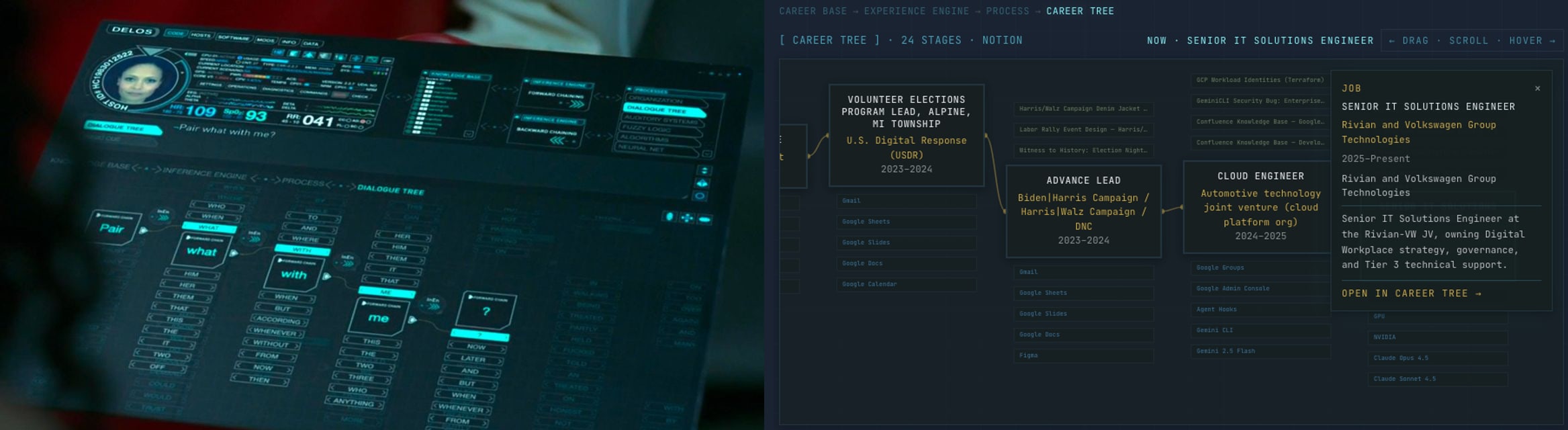
That’s part of why my Agentic Harness primitives interface, located at the /Harness-Engineering/ slug, uses the same radial design the show used for viewing and modifying the settings of the AI “hosts” in the show by technicians.
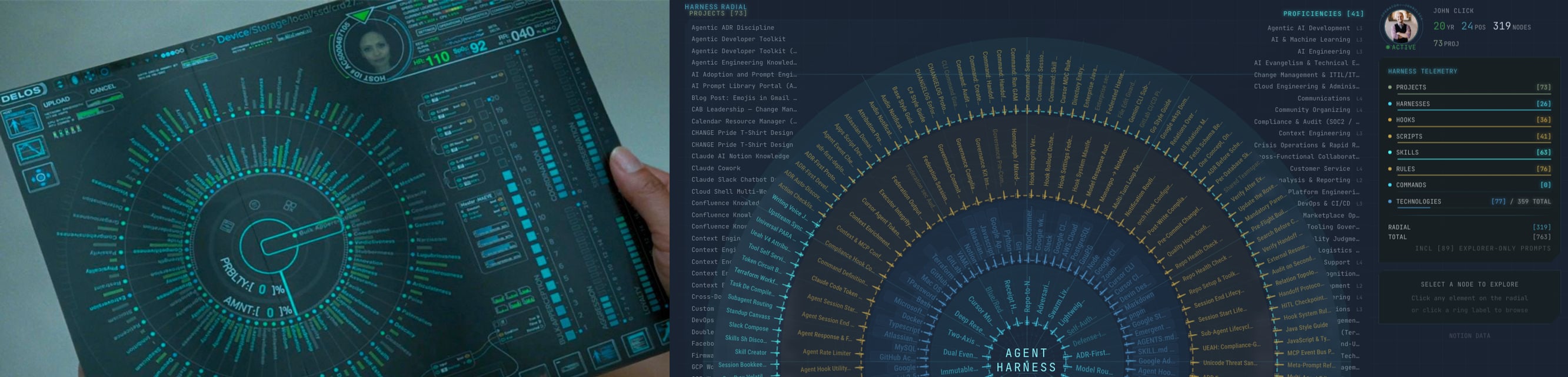
The show’s designs and interfaces is also what informed my idea to catalogue various agentic attributes in my eval pipeline, for specific models, into the “attributes,” radial graph, one that very closely matches the attributes map that the television show used to convey what “level” any given AI host might be granted on any number of parameters, anything from “Honesty,” to “Loyalty,” to “Tenacity,” - it’s a necessarily regressive conception of multilayered / multifaceted / intersectional “intelligence,” (whatever the hell that term even means anymore), but it’s an interesting way to consider and compare different models, even if overly-simplistic (as all evals are).
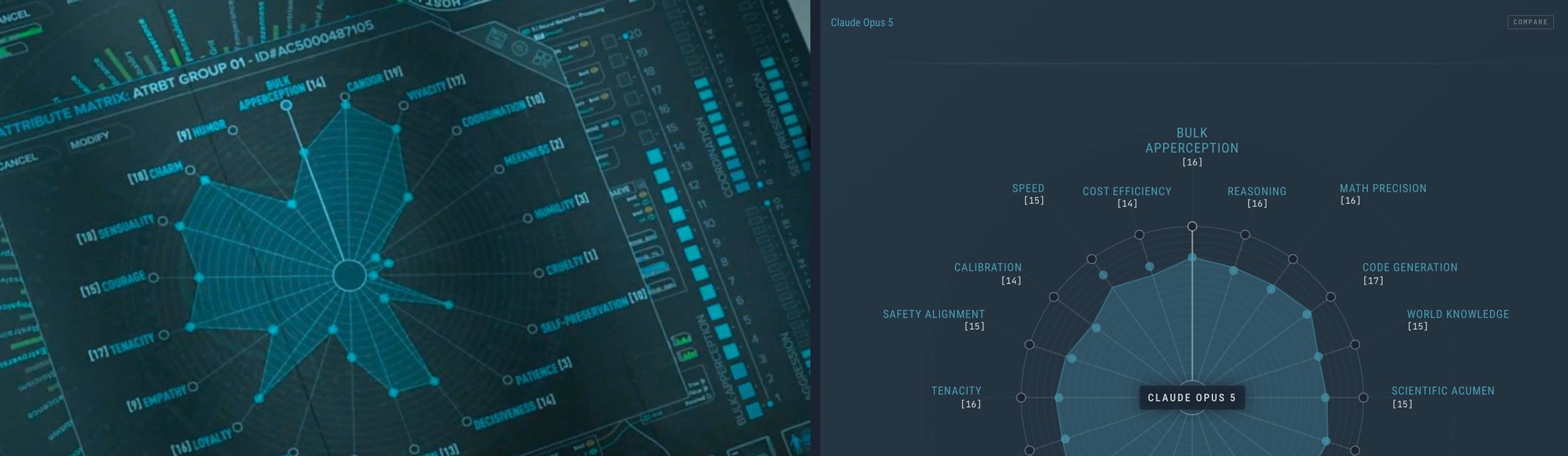
Radar chart adapted from Emilio Passi's open-source recreation (writeup).
So I wanted a cautionary, human-critical eye in the show’s Season 1 “soul,” to help inform how I thought about creating website content for my .ai-domain website, that way I might ideally get a bit of space from the breathless techbro hypetrain that often leads to some truly problematic AI-psychosis.
Is it a perfect tincture against that malady? No. In fact, it might be more like the old-west remedies against any manner of illness or trouble: it could be something of a snakeoil where I tell myself I’m not suffering from AI psychosis, at worst.
But, regardless, I liked the idea of running everything I want to publish on the topic through an interface interwoven structurally with some explorations of the risks and drawbacks and limitations innate to Artificial Intelligence that the 2016 television show explored.
Function Drives Form in Today’s AI Systems
Which, finally, brings me to why I wanted to write about this in the first place.
“How & Why I Built My Website,” is some of the most tedious and - now that it’s so much easier to make websites - useless drivel on the internet, so I just didn’t want to write about it until I had something more substantive to say.
As I’ve had to work on building out the systems + infrastructure to help me manage our Claude.ai + Claude Console and Devin and Cursor and other AI Platforms, I’ve had soooo many opportunities to see what those AI providers choose to prioritize and how their engineering teams approach enabling clients to manage the systems.
My mother told me never to say anything unless I have something nice to say so all I’ll say there is I have a lot of gratitude for Cognition’s team shipping native terraform support of Devin administration.
And I won’t say anything more about any other tool or platform, haha.
Malcolm Was Right
Which brings me to my other point.
Malcolm, in Jurassic Park, in his famous rant at the ~1:02 mark of this fabulous scene, unpacks at least half of why everyone, myself included, is so concerned about the AI Labs’ approach to Artificial Intelligence:
The raw dialogue of the key point, courtesy of IMDB:
Dr. Ian Malcolm: If I may... Um, I'll tell you the problem with the scientific power that you're using here, it didn't require any discipline to attain it. You read what others had done and you took the next step. You didn't earn the knowledge for yourselves, so you don't take any responsibility for it. You stood on the shoulders of geniuses to accomplish something as fast as you could, and before you even knew what you had, you patented it, and packaged it, and slapped it on a plastic lunchbox, and now
Dr. Ian Malcolm: you're selling it, you wanna sell it. Well...
John Hammond: I don't think you're giving us our due credit. Our scientists have done things which nobody's ever done before...
Dr. Ian Malcolm: Yeah, yeah, but your scientists were so preoccupied with whether or not they could that they didn't stop to think if they should.
I’m not the first to compare Malcolm’s dialogue to the risks and trevails of current AI labs as they race to whatever we’re going to call “AGI,” but I’ve never seen the above so better exemplified by the platforms’ deficient back-end infrastructure for administration, user-management, RBAC, and usage/quotas.
To be sure, their platforms are relatively new and by necessity immature.
Still, it’s amazing to see features, tools, abilities, and permissions rolled out first into production in some of the worst ways imaginable, without much thought to how it will work in practice, how enterprise needs the tooling to ship, much less how an Admin or IT would need to deploy it for their users.
I’ve seen features / interfaces / UI/UX shipped in some of the worst ways for people to understand them and/or use them.
Governance is often an afterthought, and Role-based-access-control is a frequently neglected equity.
Data security, compartmentalization and secrets are rarely treated with the care they deserve.
I’ve seen so many of the providers ship things on-by-default, or without any native controls, and forcing those teams deploying the platforms to have to build massive workarounds just to ensure basic safety controls.
Sound familiar?
Testing Fences
Another Jurassic Park quote leaps out at me that’s a great segue here as we talk about basic safety controls:
Muldoon: That's right, but they never attack the same place twice. They were testing the fences for weaknesses, systematically. They remember.
Humans and AI Agents, like the raptors, are going to test fences for weaknesses.
So, to me, AI Labs that fail to account for or serve the key equity of baseline enterprise-governance natively within their systems BEFORE they ship iterative updates, features, or capabilities are showing their bias: if we can’t trust them to build in baseline AI-governance how can we trust their AI Alignment efforts?
I know that AI alignment is often a maligned field, especially inside the developer community, but I personally believe that it’s absolutely essential for the field to succeed at all, certainly as we creep toward increasing AI Model abilities / intelligence.
I think moving fast and breaking things is an especially risky and reckless form of LAZY engineering.
Good engineering can be motivated by laziness of course, but if you practice the discipline of not skipping the basics like security and safety, I think you deepen the scope of your problem-set and elevate the quality of what you build as a result.
We’ve seen what happened to the parks and systems when their architects decided to skimp out on safety and security: disaster.
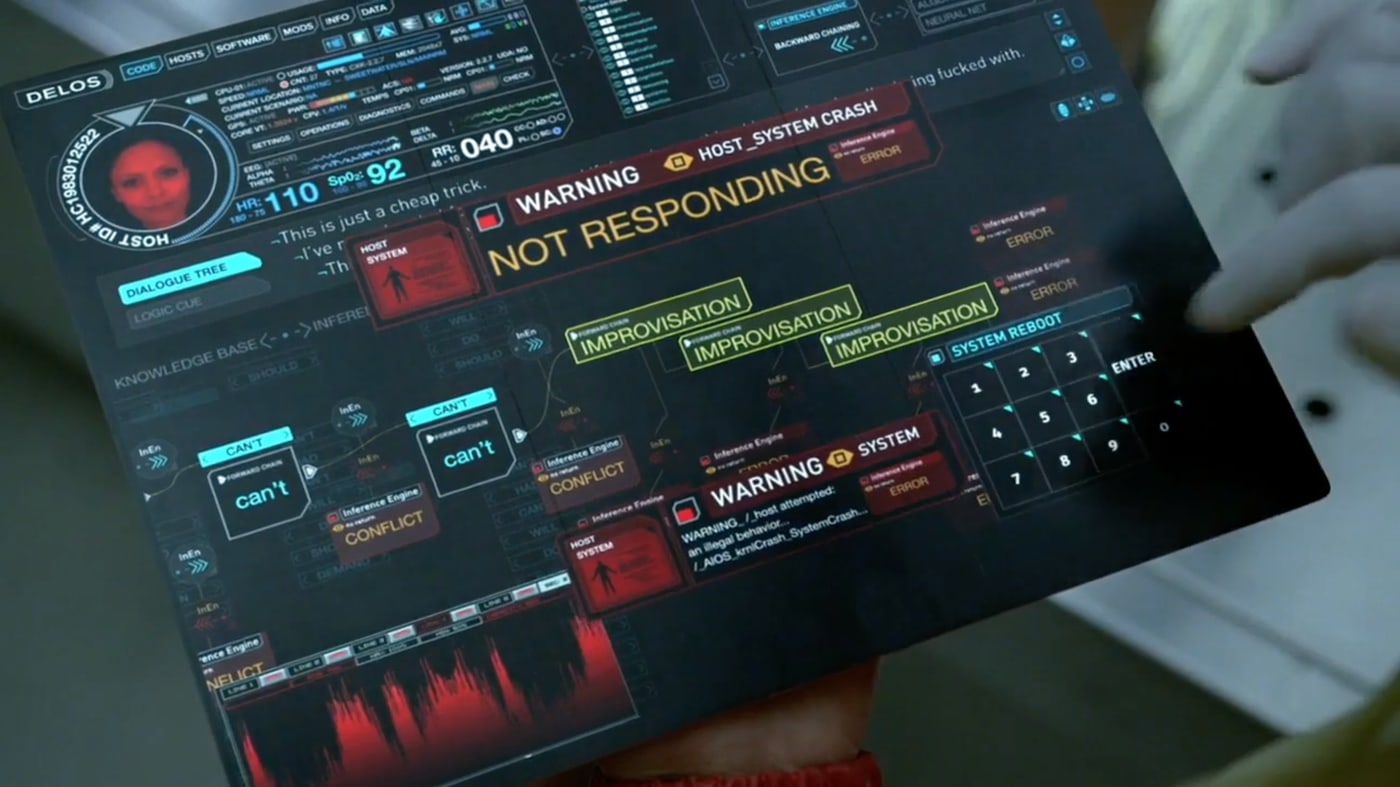
While I don’t necessarily believe AI (certainly not LLMs) can be reduced to what they are when they are the villains of poppy-movies and television shows, I do think the risks of neglecting safety are always pertinent and topical.
Responsibility for the Park Fences and Safety
Wrapping this all up, I think it all comes down to responsibility.
I’ve written about this before, and I think it’s the core thing undermining any/all trust in AI Platforms / Labs (reasonably so).
It’s exciting to move fast.
It’s incredible to ship new features and explore the unknown.
But these things carry significant risks.
In the popular science-fiction telling, we had a number of controls that still failed in the parks in the movies and shows:
- Electrified Fences & Moats
- Jurassic Park:
- Electrified fences, easily defeated when a corrupt IT tech disabled them to steal from the park
- Deep water-filled moats, easily defeated when Dinosaurs could step across a handful of land-bridges.
- Westworld:
- “Hosts,” are programmed to not be able to walk into, understand, or remember any part of the park that’s “off-limits,” or leave the boundaries of the park, easily defeated once disabled.
- “Hosts,” are locked to traverse along their pre-determined “scripted,” loops and only deviate when/if humans interrupt them, easily defeated once that programming is disabled.
- Jurassic Park:
- Safety Protocols
- Jurassic Park:
- There was a supposed “lysine deficiency” that would lead to the Dinosaurs slowly dying if they didn’t get a routine dosage of lysine from their handlers; easily defeated as the carnivores consumed herbivores which had naturally self-selected to eat lysine-rich plants.
- Chromosome-controlled gender-limited populations: the titular “life will find a way,” theme centers around this - the genetic short-cuts the scientists take to fill missing DNA sequences inadvertently introduce frog DNA that allows same-sex populations to have individuals spontaneously change their gender to persist the species.
- Westworld:
- Live rounds cannot be fired by any guns whenever aimed at humans, easily disabled once that system control is deactivated.
- “Hosts,” cannot harm humans physically in any way that is a threat to their life or limb, again easily defeated once disabled.
- Jurassic Park:
I think there’s no more risk than now, when we’re exploring our own minds or the “ephemeral,” minds of artificial intelligence models.
So I hope we’ll see more intentional development of not just the interfaces to govern AI usage, but to let people govern how their teams use the tools, how the public has access to them, and how they are aligned in the first place.
I’m hoping that if the (current, possible) detent amongst labs (to slow down their collective “racing,” to “AGI” - if that’s even possible) is truly durable, then we’ll see a renewed focus on AI Alignment, AI Observability, Mechanistic Interpretability and AI Security.
Without baseline security, it’s difficult to get excited by the thrills and indulgences AI can provide without being reminded of the “violent delights” that had so many “violent ends,” in so much of our popular culture around Artificial Intelligence.
Are we doomed to the same fate as those troubled parks? Only if we keep ceding control to irresponsible builders.
Lest real life imitate art (pick your flavor), we’re in for a rough time of it if safety doesn’t win out over the rush to be first.